Bitmap Image Compressor
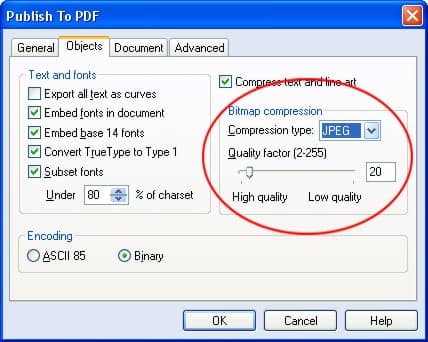
How does JPEG work? JPEG is a lossy compression format conceived explicitly for making photo files smaller and it exploits the imperfect characteristics of our perception. JPEG files are more correctly described as being in JFIF (JPEG File Interchange Format), which is a limited expression of the full JPEG standard. JPEG stands for the Joint Photographic Experts Group, a committee set up in 1986 by the CCITT standards body with the remit to 'establish a standard for the sequential progressive encoding of continuous tone greyscale and colour images'.
This it did by 1992, and the standard was ratified in 1994. The basic workflow to create a JPEG file from a bitmap is as follows. First, the bitmap image is converted from RGB to another colour space known as YCbCr. This colour space, which is also used by TV signals, encodes colour in a different way from RGB (although it covers the same colours). Two of the replacement components, Cb and Cr, are highly compressible. The Y component – the luma – is a value that indicates how bright the pixel is. The Cb and Cr components – the chroma – are the blue and red differences.
Optimize graphic files compression, reduce JPG PNG BMP TIFF size, disk space occupation. How to resize, crop, convert pictures using PeaZip images editor.
Positive discrimination To make this conversion process easy, there's a set of equations to get the luma and chroma values for a single RGB pixel. Project igi 5 pc game free download utorrent. Rather than compute these various multiplications at run-time, the results can be pre-computed and stored in tables for performance enhancements. The human eye is able to discriminate the brightness of an image much more finely than its colour information (indeed, at low levels of light we actually see in black and white, since the illumination is too dim to stimulate the cone cells in the retina). This means that the luma value needs much higher fidelity than the two chroma components do.
The JPEG format exploits the eye's imbalance by downsampling the chroma values. Downsampling is simply the process of reducing the chroma values by some factor (and therefore is the first step in losing information). In the JPEG format, there are three accepted possibilities: no downsampling at all, dividing the chroma values horizontally by two, or dividing the chroma values both horizontally or vertically by two. The next step is to split the downsampled pixels in the image into 8 x 8 blocks. Each colour component is split up separately, and each component sample goes through the same process in what follows.
Note that on many occasions, the size of the image will not be a simple multiple of eight pixels in either direction. This can result in some pixel artefacts being created along the right and bottom sides of a JPEG picture. The next step is fun, but puzzling. Each 8 x 8 block is converted into another matrix using a Discrete Cosine Transform (DCT). This transform, which is similar to a Fourier transform, analyses the frequencies of the original values along each row and column using a set of cosine waves oscillating at different frequencies and amplitudes.
The reason for doing this is that the higher frequencies can be minimized or zeroed out since we do not perceive their loss as acutely as the more energetic lower frequencies. The interesting thing about this transform is that the value with the biggest amplitude of the matrix is found at the top-left cell (known as the DC coefficient) and the values get smaller the further away from that point they get (all 63 other values are known as the AC coefficients). Generally, we'll need more bits to represent the values in this transformed matrix than can be held in a byte (which is what we've been using up to now).
The matrix reloaded This converted matrix is then quantised. This is the main lossy part of the algorithm and the stage where we minimise the higher frequencies over the lower frequencies.
 One major result of this quantisation is that many higher DCT coefficients are zeroed out, making them extremely compressible in the next step. The quantisation is accomplished by a set of 8 x 8 matrices, each one representing a different 'quality factor' for the JPEG image. Each cell is divided by the corresponding cell in the quantisation matrix and the result rounded (another lossy operation).